The Fryderyk Chopin Institute is a leading institution dedicated to the preservation, research, and dissemination of the musical heritage of Fryderyk Chopin and Polish music more broadly. Its activities include the organisation of major international events, such as the International Fryderyk Chopin Piano Competition and the International Music Festival “Chopin and His Europe”, as well as scholarly research, publishing, and educational programmes.
The Institute holds the world’s most important collections of Chopin-related sources — including musical manuscripts, letters, portraits, and memorabilia — presented at the Fryderyk Chopin Museum and preserved within the Institute’s research collections.
A key area of the Institute’s work is the digitisation, long-term preservation, and online publication of musical sources. Through the Chopin Heritage in Open Access portal (https://chopin.musicsources.pl), Chopin’s works and related materials are made freely available worldwide. In parallel, the Institute coordinates large-scale digitisation of musical prints and manuscripts from Polish archives, libraries, and museums, published on the Polish Music Heritage in Open Access portal (https://polish.musicsources.pl), in close cooperation with partner institutions across Poland.
The deposit
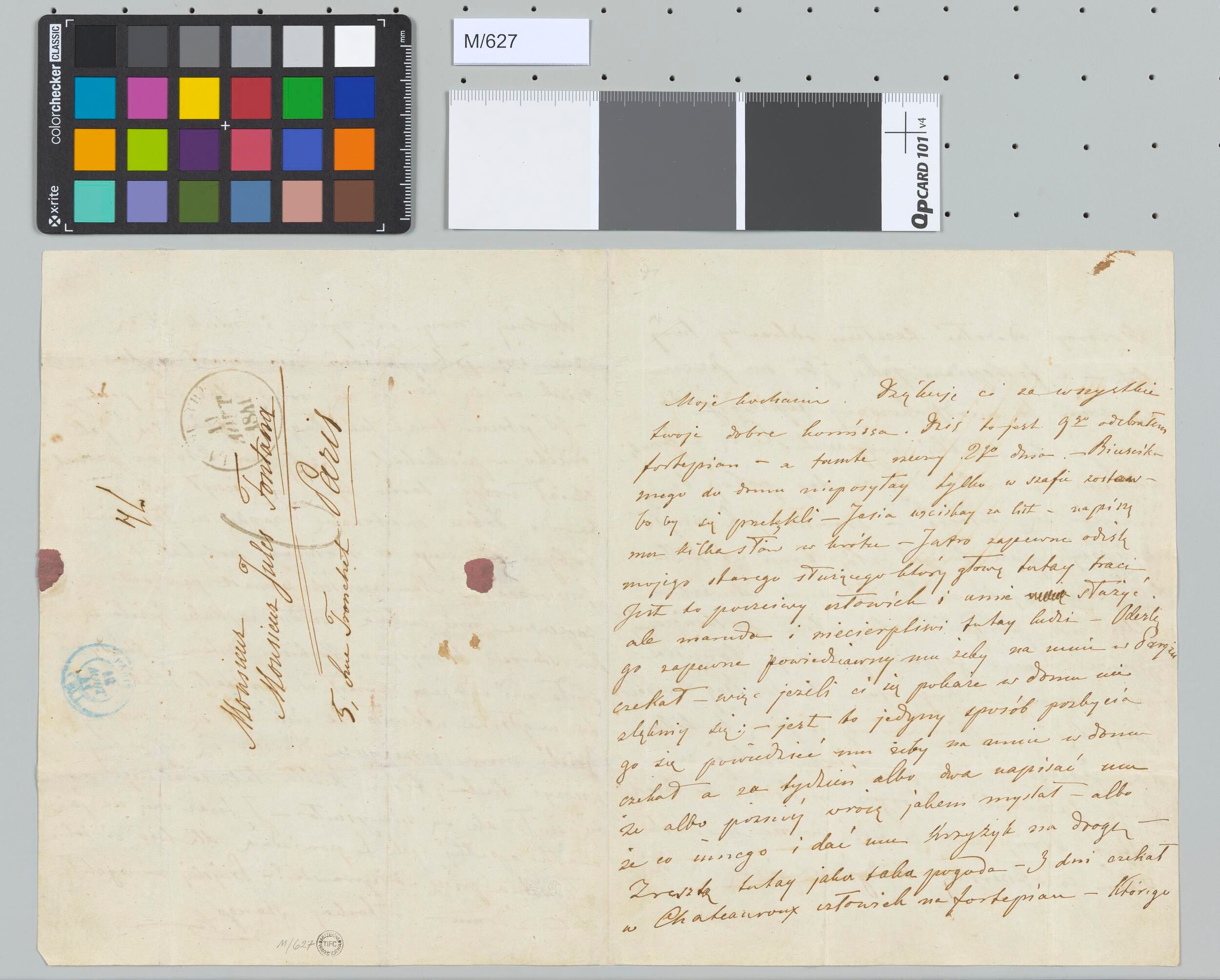
Letter from Fryderyk Chopin to Julian Fontana, “Moje Kochanie. Dziękuję Ci za wszystkie Twoje dobre komisa”
Nohant, 9 August 1941 The Fryderyk Chopin Museum, M/627
The deposit to the Arctic World Archive (AWA) comprises selected high-value digital representations of musical heritage, organised into two complementary components.The first consists of high-quality images of Fryderyk Chopin’s musical manuscripts and correspondence, including autographs and sketches that document both his compositions and his creative process. The second component includes over 23,000 musical objects — represented by approximately 400,000 digital scans — originating from Polish archives, libraries, and museums and digitised by the Fryderyk Chopin Institute within national and European projects.
Together, these materials reflect both the artistic and historical significance of Chopin’s legacy and the breadth of Polish musical heritage preserved in institutional collections across Poland. By securing these resources in a stable and secure environment, the Institute aims to guarantee their long-term availability for future generations and to safeguard irreplaceable evidence of Poland’s musical culture and research heritage.
Why piqlFilm?
Given Poland’s complex historical experience and current geopolitical context, long-term and resilient preservation of cultural heritage is a strategic priority. Digital data storage poses significant risks due to technological obsolescence and the limited lifespan of conventional storage media.
For this reason, the Institute has chosen piqlFilm technology, which records digital data onto analogue, technology-independent film with an estimated lifespan of over 500 years. As an offline medium, piqlFilm is resistant to cyber threats and extreme events, including electromagnetic disturbances.
To date, the Institute has produced 10 piqlFilms, one of which has already been deposited in the Arctic World Archive. Additional deposits are planned as part of ongoing EU-funded digitisation projects. By entrusting these materials to the AWA – one of the most secure archival facilities worldwide – the Institute ensures the long-term protection of Polish musical heritage, including Chopin’s legacy, for centuries to come.