From Barbados to the Arctic – A Unique African Slave Song Immortalised for Future Generations to Know and Understand
Abstract
The Gloucestershire Archives have chosen to safeguard a digital copy of a unique manuscript of an African work song that was chanted in the sugar fields of Barbados.
Gloucestershire Archives
Gloucestershire is a county in south west England. Gloucestershire Archives gather, keep and share historic archive collections relating to Gloucestershire and local and family history resource.

Unique Record and UNESCO Memory of the World
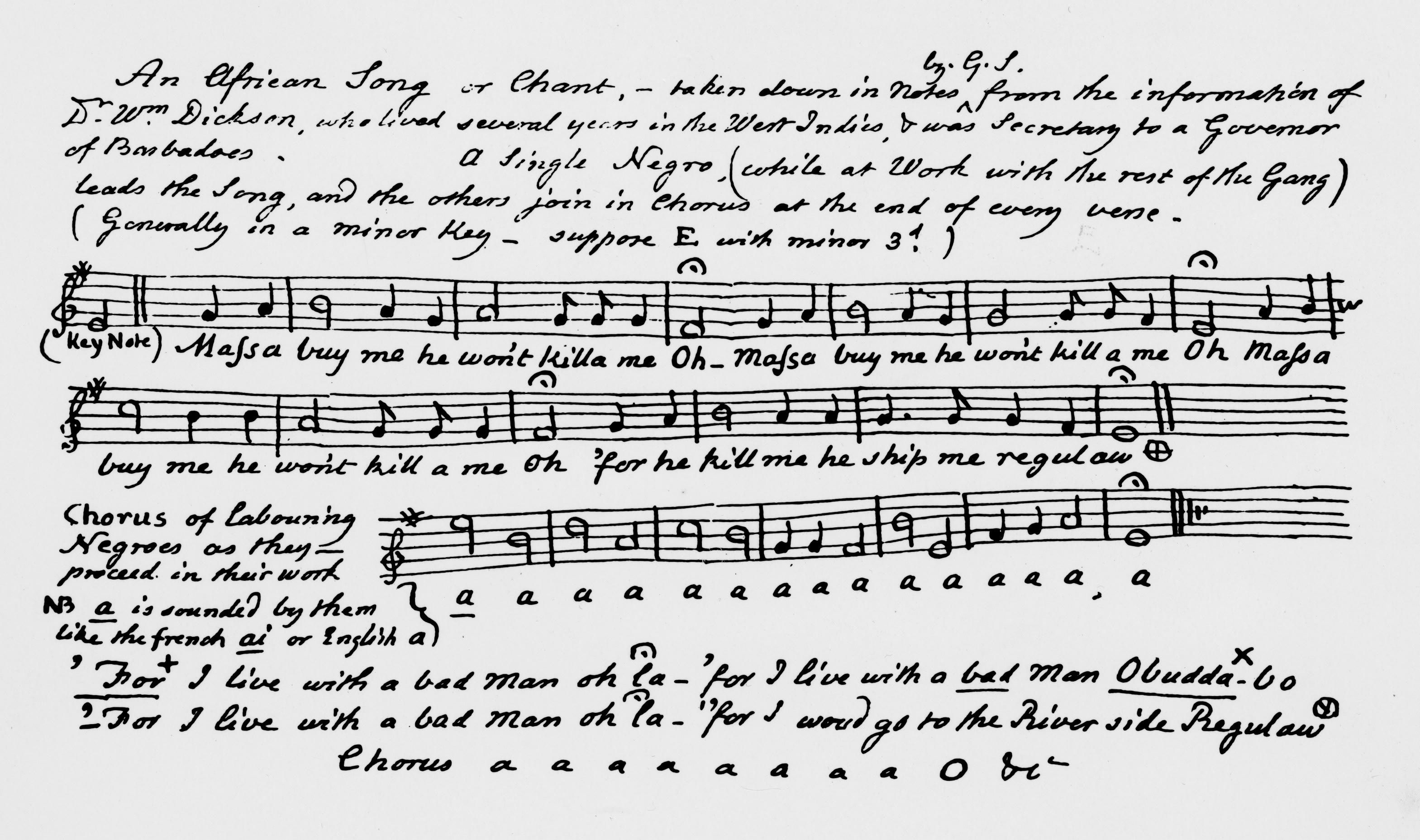
The song, An African Song or Chant from Barbados, dates from the time of enslavement (mid-seventeenth-century to 1824). This song text is the only known manuscript of an African work song that was chanted in the sugar fields of Barbados.
The song was first heard by Dr. William Dickson, when he was Secretary to Edward Hay who governed Barbados during the period 1772–1779. The song was transcribed by Granville Sharpe, a founder of the antislavery movement in Great Britain.
The song represents a part of the Barbadian documentary heritage of which there are no other known examples. It is a voice which represents how the enslaved saw their lot and how they commented on their lived experience. It also represents one of the tools that the oppressed used in their resistance and as a strategy for surviving the foul regime of enslavement.
The manuscript was submitted by Barbados and the United Kingdom of Great Britain and Northern Ireland into the UNESCO Memory of the World Register in 2016.
Future-Proofing History
An African Song or Chant was stored as a high-resolution data file onto piqlFilm, alongside a document holding a description and brief history. With this proven solution, Piql has provided a sustainable and future-proof storage medium.
Piql and the Arctic World Archive
Scotsman Dr. William Dickson lived in Barbados for about 13 years, starting in 1772. He served as Secretary to Governor Edward Hay in the 1780s and later became a leading member of the anti-slavery movement in Great Britain. Dickson came by this song, presumably by observing enslaved field workers while he lived in Barbados. The song was transcribed by Granville Sharp, a founder of the British abolitionist movement.
The document was first described in Jerome Handler’s A Guide to Source Materials for the Study of Barbados History, 1627–1834. Granville Sharp’s transcription was preserved amongst his other papers by the Sharp family, coming into the possession of the Lloyd-Baker family of Hardwicke Court, Gloucestershire, through the marriage in 1800 of Mary Sharp — heiress of Granville’s elder brother William Sharp — to Thomas J Lloyd-Baker. The Lloyd-Baker family deposited its archive in the care of Gloucestershire Archives in 1977.
Outcome
Through its deposit with the Arctic World Archive (AWA), this irreplaceable piece of Barbadian and African heritage has been secured for future generations.