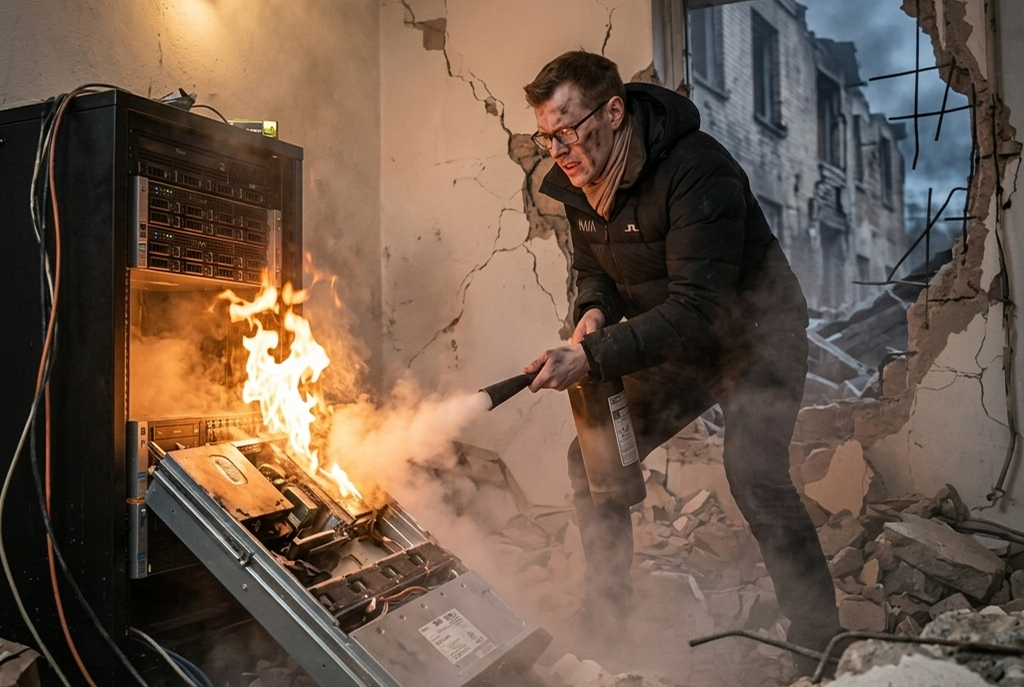
I’ve spent a lot of time recently looking at the “Cloud,” but 2026 has forced me to look back down at the earth.
For a long time, I operated under what I now call the “peace-time assumption.”
It’s that comfortable, quiet belief we all share: that the power will stay on, the borders won’t move, and the institutions we trust to hold our history will always be funded.
But I’ve realized that this assumption is a luxury we can no longer afford .
Today, when conflict breaks out, it’s about more than just land. It’s about the erasure of our identity. If you can delete a people’s records—their birth certificates, their land deeds, their ancestral stories—you can “unmake” their place in the world.
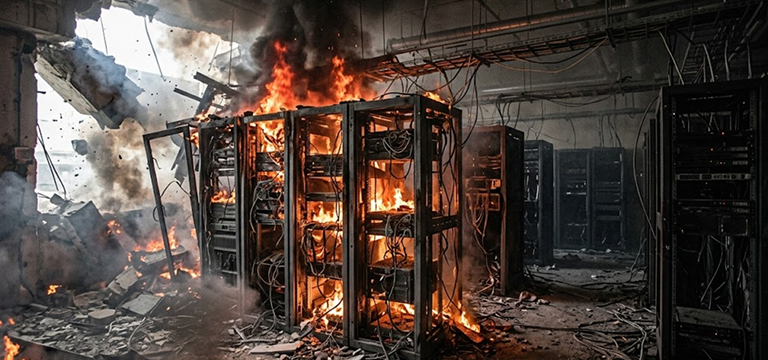
In this reality, digital archives aren’t just technical storage; they are the new front lines of cultural / historical survival.
The reality is much more fragile than I ever imagined.
We think of data as “everywhere,” but it actually lives in very specific, vulnerable buildings. When the grid fails, history starts to disappear almost immediately.
The scale of this is hard to wrap your head around.
For instance, as of 15 April 2026, UNESCO has already verified damage to over 526 cultural sites in Ukraine (153 religious sites, 275 buildings of historical and/or artistic interest, 39 museums, 33 monuments, 21 libraries, 4 archaeological sites, 1 archive).
It leaves me with one question that I think we all need to answer: If the building housing your records were caught in a conflict zone tomorrow, would that history survive the first 48 hours of a total power failure?
If the answer is “no,” then we aren’t really protecting our heritage.
We’re just holding onto it and hoping for the best.
Three ways war kills Memory
When I look at the chaos in the world today, I’ve realized that war doesn’t just destroy the present; it systematically dismantles the past. It’s not always a single explosion that does it, either.
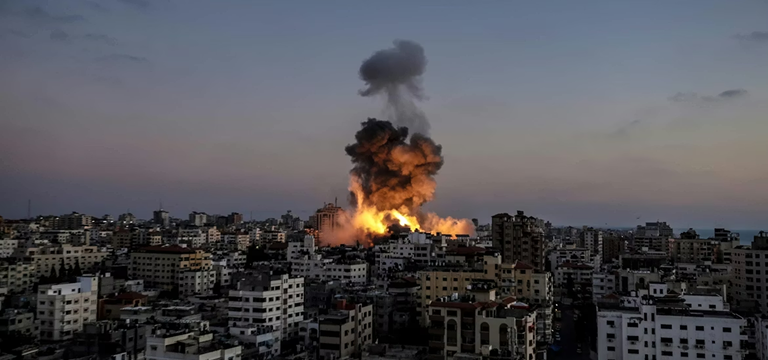
In my work, I’ve seen that memory dies in three distinct, almost clinical stages:
Mechanical death:
We tend to think of data loss as someone hitting a “delete” button.
In reality, it’s much more mundane. Digital archives are like living organisms—they need a constant “heartbeat” of electricity and specialized cooling to keep their hardware from literally melting.
When conflict strikes, the power grid is almost always the first thing to go. Without fans and climate control, the drives degrade in the heat of a non-ventilated bunker. Within 48 hours of a blackout, a nation’s digital memory can become “dark data”—physically there, but technically dead.
Digital cultural cleansing:
There is a darker side to modern warfare that goes beyond collateral damage.
History has taught us that to erase a people, you must first erase their proof of existence.
I’m talking about the deliberate, surgical targeting of national registries, land deeds, and cultural archives. If an aggressor can wipe the digital proof of who owns a home or where a child was born, they can unmake a society more effectively than any bomb.
Throughout history, the first thing a conqueror does is burn the archives to ensure the “new” history is the only one left:
- Around 213 BCE, Emperor Qin Shi Huang ordered the burning of historical records from defeated states. He wanted history to begin with him, destroying any scholarly evidence that a different way of life ever existed.
- During the Spanish conquest, Bishop Diego de Landa famously burned almost the entire library of Maya bark-paper books. In a single afternoon, centuries of Mayan science, history, and genealogy were erased, leaving a “defeated” people with a shattered memory.

The deliberate destruction of cultural symbols and records is still used today as a tool to “rewrite history” and demoralize populations during occupations. The only thing that has changed is the speed. Where it once took a bonfire and months of effort to erase a culture, today it takes a single cyber-attack or a well-placed strike on a data center.
In 2026, the “delete” button has become the most powerful weapon of war.
Sovereignty trap:
Finally, there’s the risk that doesn’t involve a single explosion: the loss of control.
Because we love the convenience of the “Cloud,” many nations store their most precious data in servers located in North America or Western Europe.
But as geopolitical lines harden, these clouds may now suddenly evaporate.
If a country is hit with sanctions or cut off from the global internet (the “Splinternet”), their data stored abroad becomes a hostage of geography.
You might “own” the bits and bytes, but if you don’t own the physical pipes or the land where the servers sit, you no longer have sovereignty over your own history. Your heritage becomes a bargaining chip in a game you can’t play.
Passive survival strategy:
To survive the chaos I’ve described, we have to shift our perspective entirely. We need to stop talking about IT security and start talking about Civilizational Insurance. If we want our heritage to be truly “war-proof,” we must move away from the fragile cycle of active maintenance and embrace “passive survival.”
This is exactly the challenge we’ve set out to solve at AWA.
We’ve realized that digital data is, quite literally, “fragile by nature.”
As we explored in our previous deep dive on why digital records are inherently at risk, data isn’t a permanent monument; it is a high-maintenance guest that requires constant attention just to stay alive.
Just as a flight recorder is designed to stay intact even when the rest of the plane is lost, our archives must be built to survive the “Absence of a State.”
Here is how we try to make that happen:
- Geographic neutrality: If you store your history in a geopolitical hotspot, you are essentially leaving it on the chessboard. At AWA, we’ve positioned our vault in Svalbard, Norway. It is a unique demilitarized zone governed by an international treaty. Deep inside a mountain mine, the data is protected not just by layers of rock, but by a global consensus of peace. It effectively removes a nation’s cultural assets from the theater of war entirely.
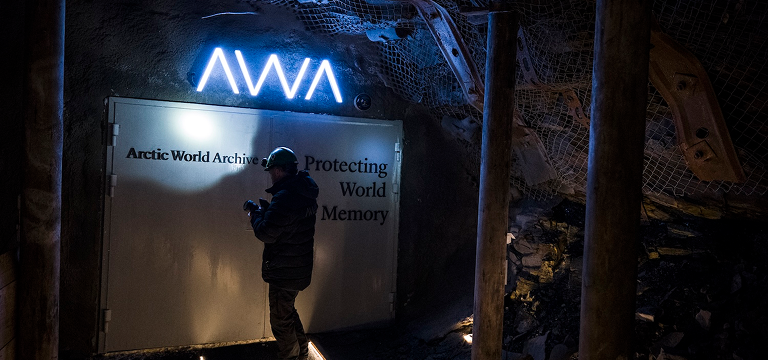
- Technological independence: We are currently addicted to “live” systems that require a functioning world to stay alive. But heritage shouldn’t need a help desk or a power company. By using piqlFilm, we’ve moved to a system that is Offline by Design. It requires no power, no cooling, and no internet to exist for 500 years or more.
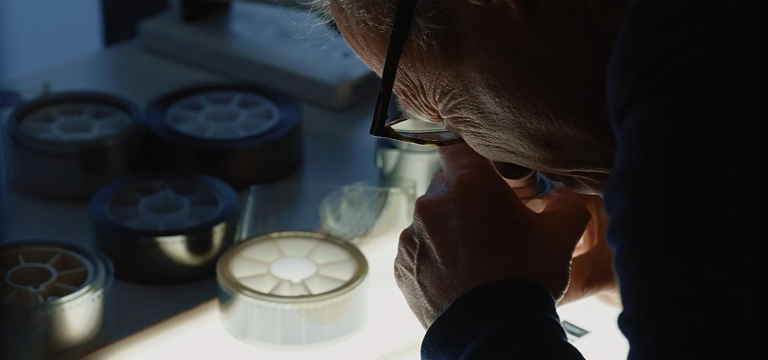
The most human part of this technology—and the answer to data’s “fragile nature”—is that it is self-describing. The data is stored as high-resolution optical motifs. Even if every software company on earth went bankrupt tomorrow, your records could still be “read” using nothing more than a light source, a camera, and a computer. In a worst-case scenario, you could even use a magnifying glass!
In the end, this is the difference between Security and Resilience.
Security is about building a better lock;
Resilience is about ensuring that even if the building falls, the treasure remains.
By designing for the moment when the state isn’t there to help, we ensure that our history is waiting for us when we’re ready to rebuild.
Heritage protection is civilizational insurance.
We don’t protect history for the easy times but for the moments when it is all we have left to rebuild with.
If you are ready to move your records beyond the battlefield and into a future of passive survival, reach out to me directly here on LinkedIn or via email—let’s ensure your legacy is truly war-proof.