Cultural memory, should we remember — or forget?
Published
February 16, 2026
In every society, memory is not only inherited but shaped. Through archives, memorials, education, and rituals, communities decide what is worth preserving and transmitting to future generations. At the same time, other events, voices, and experiences gradually fade, intentionally or not, into silence.

This tension between remembering and forgetting is not new.
Long before the digital era, societies faced the same fundamental question: should the past be permanently preserved, or selectively remembered?
What has changed today is not the nature of cultural memory, but its scale. Digital technologies make it possible to record, store, and replicate vast amounts of information, raising new expectations --- and new responsibilities.
As the technical limits of preservation recede, cultural memory becomes less a matter of capacity and more a matter of choice. Remembering is no longer only about preventing loss; it is about deciding what deserves continuity, meaning, and care over time.
In this context, the question is no longer whether we can remember everything, but whether we should --- and what role forgetting still plays in shaping shared memory.
At its core, cultural memory is a social and collective phenomenon : it is not merely the sum of individual recollections, but a shared understanding of the past that connects people across generations. It plays a fundamental role in shaping identity, values, and social cohesion.
As the German cultural theorist Aleida Assmann has defined it:
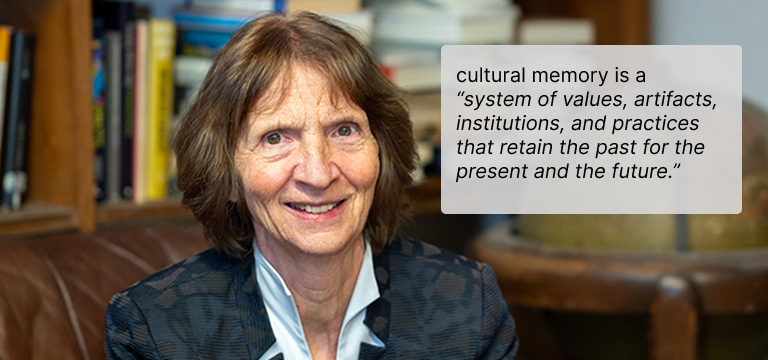
This form of memory encompasses texts, rituals, monuments, stories, and other symbolic carriers that help societies make sense of their history and transmit it over time.
These collective memories are not passive records: they actively structure how communities see themselves and understand their place in history.
Early sociological theorist Maurice Halbwachs argued that memory is always shaped within social frameworks ---that is, individual recollections are reconstructed in the present through shared norms, values, and practices rather than preserved as fixed records of the past.
Remembering, then, is not merely an act of preservation; it is an act of recognition, identity formation, and meaning-making. Through shared memory, communities articulate what is important, what embodies collective experience, and what should guide their present and future actions.
From national histories to local traditions, cultural memory provides orientation in time and a sense of belonging that surpasses individual lives.
While remembering shapes identity, purpose, and continuity, forgetting plays a complementary and equally important role in how societies deal with their pasts.
In cultural memory studies, remembering and forgetting are not simply opposites --- they are interdependent processes that together determine what remains salient and what recedes into silence.
Forgetting can occur in many ways --- through the loss of attention, the fading of lived experience, or evolving social priorities that make certain events less central to contemporary identity.
Cultural memory scholars note that forgetting is not merely accidental absence but often the result of shifting frameworks and social dynamics that no longer sustain certain memories within collective discourse. In the work of memory theorist Jan Assmann, forgetting is linked to changes in “frames”: the cultural, institutional, and symbolic contexts that make memory durable in the first place. When these frames change, memory weakens or disappears.
Indeed, early work on collective memory distinguished remembering and forgetting as part of the same social architecture. As Maurice Halbwachs argued, individual memory is shaped through its place in collective life, and when shared social contexts shift, memories can be reshaped or lost altogether.
There are several important reasons why forgetting matters:
From this perspective, forgetting can be an adaptive social process that enables renewal, integration, and continuity in complex and changing environments.
Far from being a deficit, controlled forgetting can be an essential counterpart to remembrance --- allowing cultures to live with their pasts instead of being constrained by them.
In the digital era, the question of remembering or forgetting is no longer constrained by technical limitations. Societies now possess the ability to record and store vast quantities of information with unprecedented ease. Yet this apparent abundance introduces a new challenge: durability is not the same as permanence.
Digital memory is often associated with immediacy and accessibility, but its long-term reliability remains fragile.
Formats become obsolete, platforms disappear, and infrastructures depend on continuous maintenance and institutional stability.

As a result, cultural memory that is meant to serve future generations requires intentional strategies for longevity.
This shift transforms cultural memory into a matter of responsibility rather than capacity.
The key question is no longer “can we preserve this?” but “for how long, under what conditions, and for whom?”
Remembering, in this context, becomes a forward-looking act: a commitment to ensure that selected knowledge, narratives, and records remain intelligible and authentic well beyond the present.
Initiatives such as Arctic World Archive reflect this long-term perspective by focusing on preservation across centuries rather than decades. By prioritizing stability, readability, and independence from short technological cycles, such approaches highlight a fundamental dimension of cultural memory in the digital age: the intention to preserve meaning beyond immediate use or visibility.
Ultimately, cultural memory is shaped by the decisions societies make today about endurance. Choosing to preserve for the long term is not an act of accumulation, but an act of care --- one that acknowledges the limits of the present and the responsibility owed to the future.
Between remembering and forgetting lies a third path: the conscious choice of what should endure.
Cultural memory is neither an automatic process nor a neutral one. It is shaped by choices, values, and long-term intentions that reflect how societies relate to time itself. In an era where preservation is technically possible at unprecedented scale, the true challenge lies in discernment: deciding what deserves continuity, care, and responsibility beyond the present moment.
The way these decisions are made today will quietly define how future generations understand the past --- and their place within it.

Business legacy strengthens trust, culture, and continuity when preserved for centuries with the right archival strategy.
Read more
...
Read more
Get free access to the AWA platform and see how you can manage, preview, and prepare your preservation projects.
