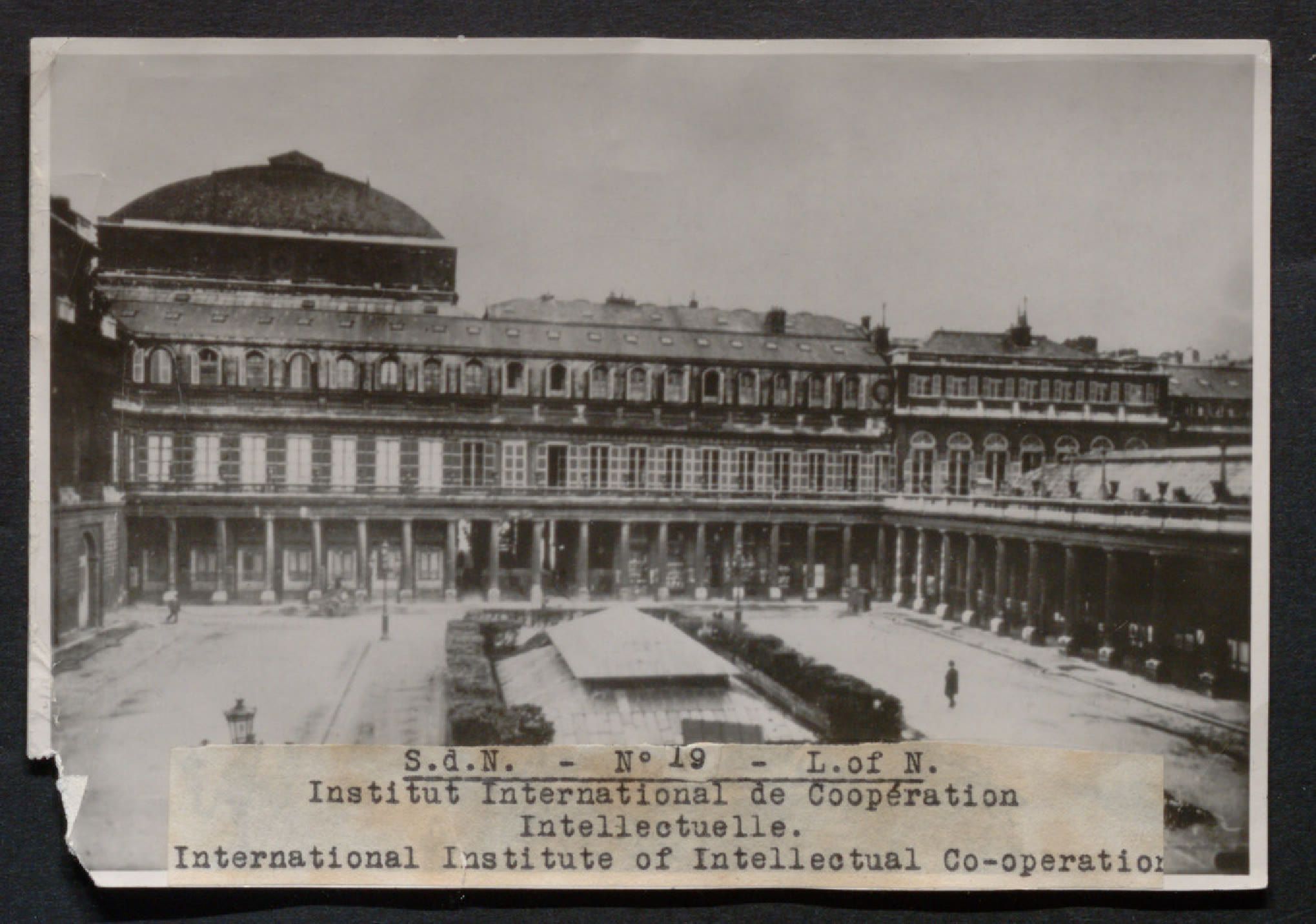
On 16 January 1926, the International Institute of Intellectual Cooperation (IIIC) opened its doors in Paris. Created as the operational arm of the League of Nations’ International Committee on Intellectual Cooperation, the Institute transformed the ideals of intellectual cooperation into concrete action—promoting dialogue, knowledge exchange and the circulation of ideas as a means to prevent war and foster international peace. Bringing together leading thinkers of its time—among them Henri Bergson, Albert Einstein, Marie Curie, Gabriela Mistral, Rabindranath Tagore and Paul Valéry—the IIIC embodied a pioneering vision: that peace is built not only through treaties, but through education, culture and intellectual exchange.
In June 1940, the records of the IIIC and its staff were evacuated to Great Britain and returned to Paris mid-July of the same year. During the German occupation of France from 1940-1944, some material was lost. In 1946, UNESCO inherited the archives of the Institute, including its publications. Conserving and indexing the archives was one of the first tasks of the archives service of UNESCO in 1947.
Today, UNESCO is the custodian of the IIIC archives, inscribed on the Memory of the World International Register in 2017. From 2017 to 2019, thanks to the support of the People of Japan, UNESCO Archives was able to digitize the documents and correspondence of the IIIC and make them freely accessible online. In 2026, the IIIC documents will now enjoy enhanced security through their migration to PIQL film and deposit in the Arctic World Archive.
In the next five years, thanks to the support of the Sharjah Book Authority, UNESCO Archives will digitize the publications of the IIIC, completing the digitization of the entire IIIC archives. A century later, the Institute’s founding conviction remains profoundly relevant and continues to guide UNESCO’s mandate: building peace in the minds of women and men.